
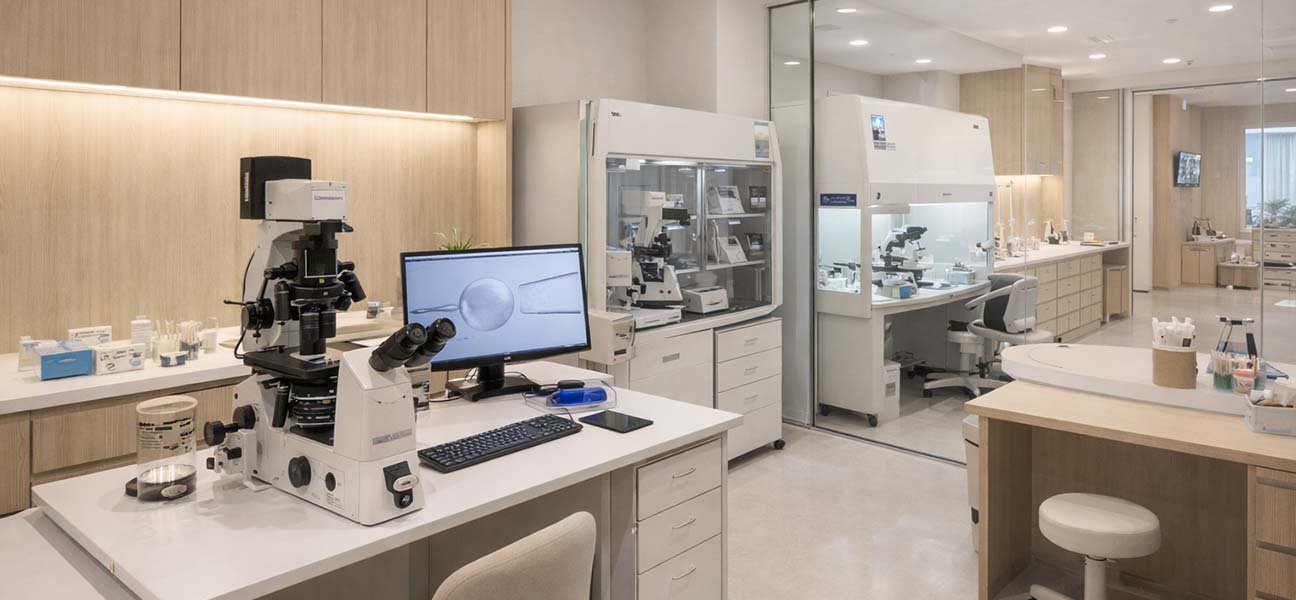
Current Application of Vitrification in Georgia
Assisted reproductive institutions in Georgia widely use vitrification for cryopreservation of embryos, oocytes, and ovarian tissue. This technique uses extremely high concentrations of cryoprotectants and ultra-rapid cooling rates (up to -2000°C/min) to directly transform cellular contents into a glassy state, thereby avoiding physical damage to the cytoskeleton and organelles caused by ice crystals. Compared to traditional slow freezing, the post-thaw survival rate of vitrification reaches over 90% in most fertility centers, and some laboratories in Georgia report embryo survival rates exceeding 95%.
Technical Principles and Key Parameters
The core of vitrification lies in "ultra-rapid cooling" and "high-concentration cryoprotectants." During the procedure, embryos or oocytes are placed in a solution containing cryoprotectants such as ethylene glycol and DMSO, then quickly plunged into liquid nitrogen. Laboratories in Georgia typically use open or closed carriers (e.g., Cryotop, Cryoleaf). Closed designs reduce the risk of cross-contamination but have slightly slower cooling rates than open ones. It is important to note: higher cryoprotectant concentrations cause greater osmotic shock to cells, so the equilibration time and exposure duration must be adjusted for different developmental stages (e.g., zygote, cleavage stage, blastocyst).
| Parameter | Vitrification | Slow Freezing |
|---|---|---|
| Cooling Rate | >1000°C/min | 0.3-0.5°C/min |
| Ice Crystal Formation | Almost none | Possible small ice crystals |
| Cell Damage | Cold shock + chemical toxicity | Mechanical damage from ice crystals |
| Typical Survival Rate | >90% | 70-85% |
| Procedure Time | 1-3 minutes | 1-2 hours |
Suitable and Unsuitable Situations
Suitable: ① Oocyte freezing (fertility preservation for single women or cancer patients); ② Blastocyst freezing (especially those with high morphological scores); ③ Cycles requiring delayed transfer (e.g., waiting for PGT results, suboptimal maternal endometrial condition); ④ Storage of accumulated embryos from repeated cycles.
Unsuitable: ① Freezing motile sperm (survival rate lower than liquid nitrogen storage, though still partially used in Georgia); ② Very poor sample quality (e.g., severely fragmented embryos), as further developmental potential after thawing is limited; ③ When laboratory procedures are not standardized, cryoprotectant toxicity may lead to cell apoptosis.
It should be specifically noted: vitrification is not "zero-damage." Membrane phase transitions, osmotic fluctuations, and rehydration during the warming process can cause microstructural changes in cells under ultra-low temperatures. Therefore, reputable fertility centers in Georgia strictly record the liquid nitrogen tank temperature, carrier batch, and operator for each freezing cycle.
Common Differences Among Georgian Laboratories
Different institutions vary in freezing carriers, cryoprotectant formulations (commercial pre-made solutions vs. self-prepared), and equilibration time (room temperature vs. 37°C operation). Patients are advised to request the center's average embryo survival rate data for the past three months and confirm whether closed carriers are used to reduce the risk of pathogen contamination. Some laboratories add antifreeze proteins for cumulus-oocyte complex freezing, while ovarian tissue freezing requires special processing.
Actual Procedure and Timeline
Using frozen-thawed blastocyst transfer as an example, the general process is as follows:
- Freezing Day: Blastocysts are assessed on culture day 5 or 6. Those meeting freezing criteria undergo vitrification, are placed on labeled carriers, and then plunged into liquid nitrogen. The entire process takes about 15 minutes.
- Thawing Day: Usually performed on day 13-16 of a natural or artificial cycle for endometrial preparation. Thawing takes only 3-5 minutes, followed by 1-2 hours of recovery in culture medium, with reassessment of survival and expansion.
- Transfer: Surviving embryos of acceptable quality are transferred. Remaining embryos can be re-frozen (secondary freeze-thaw survival rate typically decreases by 5-10%).
What to Prepare: Patients need to complete endometrial assessments (e.g., ultrasound, hormone tests) in advance. For artificial cycles, estradiol and progesterone must be taken as prescribed. Starting the day before transfer, it is recommended to avoid strenuous exercise and maintain a normal routine.
How Long It Takes: From the start of endometrial preparation to transfer completion, a natural cycle takes about 14-20 days, and an artificial cycle about 20-30 days. Frozen embryos can be stored long-term (several years in liquid nitrogen), but Georgian law typically sets the storage period at 5 years, extendable with renewal fees.
Physician Decision Logic and Common Misconceptions
Physician Perspective: For patients needing to wait for genetic test results or those with suboptimal maternal conditions, frozen embryo transfer is superior to fresh embryo transfer. However, not all embryos are suitable for freezing—vitrification survival rates for early cleavage-stage embryos (day 3) are lower than for blastocysts, and post-thaw developmental potential varies greatly. Therefore, reproductive doctors in Georgia prefer to culture embryos to the blastocyst stage before freezing, unless the patient has few embryos or a risk of ovarian hyperstimulation syndrome.
Common Misconceptions: ① Believing vitrified embryos have exactly the same quality as fresh embryos—in reality, the freeze/thaw process can cause irreversible damage to some embryos, with clinical pregnancy rates about 5-10% lower than fresh embryos; ② Thinking that longer storage makes embryos older—biological reactions nearly cease in liquid nitrogen, so storage duration does not affect quality, but improper tank management (e.g., low nitrogen levels, frequent tank opening) can cause damage; ③ Assuming all Georgian clinics use the same technology—patients should verify laboratory certifications (e.g., ISO 15189, ESHRE quality system) and the embryologists' years of experience.
Easily Overlooked Details and Risks
Details: ① Oocyte freezing requires precise timing; an equilibration time error exceeding 30 seconds can affect survival rates; ② Embryos carrying pathogens (e.g., hepatitis B, HIV) should be stored separately in dedicated liquid nitrogen tanks—some Georgian centers have clear zoning for this; ③ Post-thaw culture medium should be pre-warmed to 37°C and equilibrated with 5% CO₂, otherwise temperature shock can cause embryo stress.
Risks: ① Post-thaw embryos may lose some cells (e.g., inner cell mass or trophectoderm cells), affecting subsequent implantation ability; ② Rare cases of carrier breakage or label detachment leading to embryo loss; ③ The risk of multiple pregnancy still exists; single blastocyst transfer is generally recommended for frozen embryo transfers to reduce obstetric complications.
Differences Among Age Groups
For patients under 35, post-thaw survival rates for oocytes or embryos are typically high (>95%), and the proportion continuing to develop to blastocysts is ideal. For patients aged 36-40, due to decreased tolerance of oocytes to vitrification, survival rates may drop to 85-90%. Patients over 41 not only have fewer oocytes/embryos but also higher rates of chromosomal abnormalities, resulting in a lower proportion of embryos available for transfer after freezing and thawing. Georgian fertility centers often adopt a "cumulative freezing" strategy for older patients—collecting embryos from multiple egg retrievals, then thawing all at once for PGT and transfer.
Frequently Asked Questions (From a Practitioner's Perspective)
Q: Is vitrification expensive in Georgia?
Costs are usually included in the IVF cycle fee. Some clinics charge separately for additional freezing (e.g., surplus embryos from the first cycle) and storage, typically $200-500 per year. Compared to slow freezing, vitrification consumables are slightly more expensive, but it saves the cost of programmable freezing equipment, so the overall impact on patient expenses is minimal.
Q: If my embryos are frozen in Georgia, can they be transported back to my home country?
Theoretically yes, but it involves international liquid nitrogen transport (requiring dry shippers, customs quarantine, time window constraints, etc.), which is very risky, and most Georgian clinics advise against transport abroad. Local transfer is strongly recommended.
Q: Does repeated freezing/thawing affect embryos?
Multiple freeze-thaw cycles cause cumulative damage. Clinical data show a decrease in survival rate of about 5-8% for the second thaw, and significantly lower for the third or more. Therefore, re-freezing is only recommended for exceptional cases with surplus blastocysts of very high quality.
Physician Recommendations and Next Steps
For patients considering assisted reproduction in Georgia, it is recommended to: ① Thoroughly understand the target clinic's freezing technology details before ovarian stimulation, including carrier type and historical thaw survival rates (request written data); ② If planning oocyte freezing for fertility preservation, do so preferably before age 35, and assess ovarian reserve (AMH, antral follicle count); ③ Ensure endometrial morphology is adequate before transfer (thickness >7mm, good blood flow signals), and consider hysteroscopy to rule out polyps, adhesions, or other abnormalities if necessary; ④ Continue luteal support after transfer, typically checking serum HCG 10-12 days post-transfer to confirm pregnancy.
Risk Reminder: Although vitrification is well-established, there is a very low probability (<0.1%) of liquid nitrogen tank failure leading to total embryo loss. Choose a fertility center equipped with electronic liquid nitrogen monitoring systems and multiple backup tanks. Additionally, all freezing procedures require signed informed consent, clearly outlining potential failure risks and subsequent management plans.
Comments (0)