
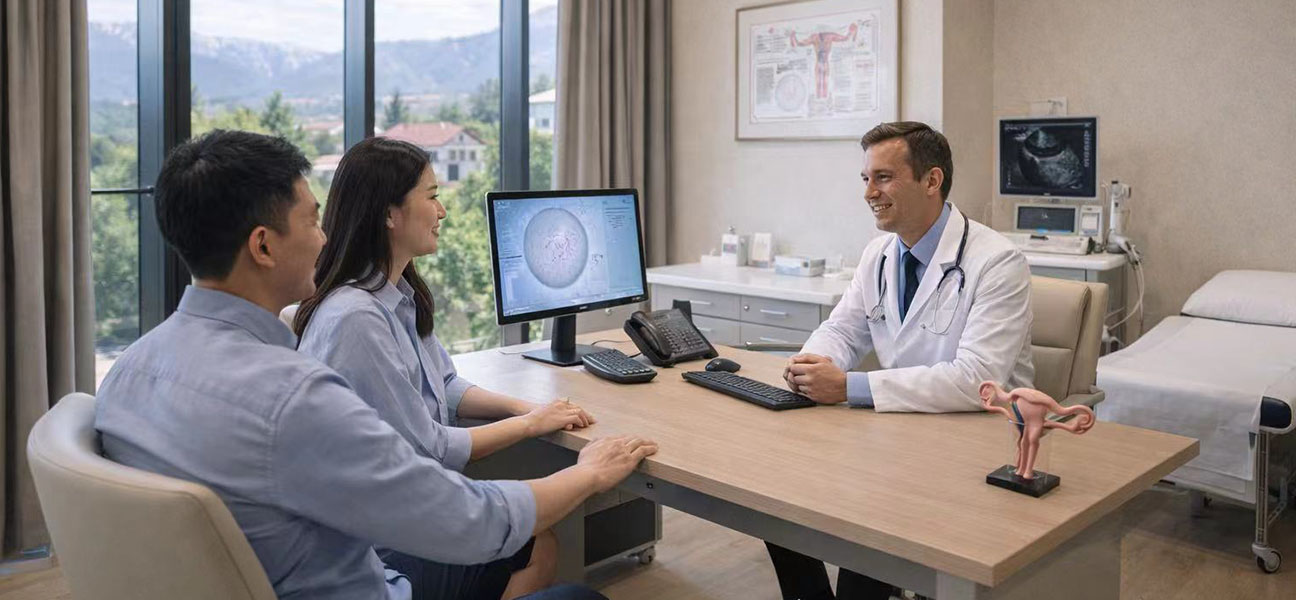
Real Consultation Scenario: Ms. Zhang, Who Flew Back to China on Day 5 After Transfer
Ms. Zhang flew back to Shanghai on the 5th day after a frozen embryo transfer in Georgia. On the 3rd day after arrival, she experienced lower abdominal distension and slight vaginal bleeding. She immediately contacted her primary physician in Georgia via telemedicine and also had an emergency check-up at the reproductive center of a top-tier hospital in China. The subsequent management of this case—including medication adjustment, rest recommendations, and follow-up milestones—forms the core answer of this article.
Post-IVF care after returning from overseas is not simply about "taking medication as prescribed." Patients must navigate multiple variables including jet lag, medication continuity, thrombosis risk, infection prevention, and psychological fluctuations. The following sections break down each aspect.
What to Do Immediately After Returning from IVF in Georgia
1. Medication Continuity: Confirm Remaining Dosage and Prescribe in Advance
Georgian doctors typically prescribe about 14 days of luteal phase support medication (progesterone injections, vaginal gel, or oral progesterone). Before returning, ensure the medication supply covers the period until your first return visit for a pregnancy test. If the supply is insufficient, obtain a prescription in advance from the reproductive center of a top-tier hospital in China. Brand names may differ between countries, but medications with the same active ingredients are interchangeable. For example, "Utrogestan," commonly used in Georgia, has the same active ingredient as "Progesterone Soft Capsules" in China; adjust the dosage as per your doctor's instructions.
2. Jet Lag Adjustment: The 48-Hour Window After Transfer is Crucial
The time difference between Georgia and Beijing is 4 hours (3 hours during daylight saving time). The long flight itself does not directly affect embryo implantation, but a disrupted day-night cycle can lead to irregular timing of luteal phase support medication. It is recommended to adjust your medication schedule according to the destination country's time before takeoff and start taking medication according to Beijing time on the first day after landing. If using progesterone injections, ensure that a local medical facility can administer them upon arrival.
Easily Overlooked Detail: Thrombosis Risk and Long-Haul Flights
Estrogen levels are high after ovarian stimulation and egg retrieval for IVF, and progesterone medications after transfer further increase blood viscosity. Long-haul flights (over 4 hours) represent a high-risk scenario for venous thromboembolism (VTE). Below are specific assessment and management criteria.
| Risk Stratification | Characteristics | Recommended Measures |
|---|---|---|
| Low Risk | Age <35, no history of thrombosis, flight duration <6 hours | Move calves every 1-2 hours during flight, wear medical compression stockings (Grade 1 pressure) |
| Moderate Risk | Age 35-40, BMI >28, history of gestational hypertension or diabetes | Compression stockings + consult doctor before flight about using low molecular weight heparin |
| High Risk | History of DVT/PE, positive antiphospholipid antibodies, family history of thrombosis | Must use prophylactic dose of low molecular weight heparin under medical guidance, and arrange D-dimer test promptly after landing |
If a patient returning from IVF in Georgia experiences unilateral leg swelling, pain, increased skin temperature, or sudden chest tightness/difficulty breathing, they should seek emergency care immediately to rule out pulmonary embolism. These symptoms can be mistaken for "leg swelling after sitting" or "anxiety," but delayed treatment can be fatal.
Doctor's Perspective: Strategies for Coordinating Follow-up Across Different Hospitals
When is it Suitable to Have the First Pregnancy Test at a Top-Tier Hospital in China?
If the Georgian doctor provides electronic transfer records and a subsequent medication plan, and the Chinese hospital recognizes the overseas embryo transfer, the patient can have blood drawn for HCG at a local hospital 12-14 days after transfer. It is advisable to contact the Chinese reproductive center in advance to confirm if they accept overseas IVF patients for pregnancy follow-up. Some top-tier hospitals in Shanghai, Beijing, and Guangzhou (e.g., Shanghai Ninth People's Hospital, Peking University Third Hospital, First Affiliated Hospital of Sun Yat-sen University) explicitly accept such patients.
When is it Not Suitable to Have the Pregnancy Test in China?
If the patient has a complex medical history (e.g., recurrent implantation failure, immune abnormalities, requiring medication adjustments per the Georgian lab's specific protocol), or if the Chinese hospital cannot access the original embryo culture report, it is recommended to return to Georgia for the pregnancy test and early ultrasound. Some patients choose to return to Georgia once around day 28 after transfer (for ultrasound to detect fetal heartbeat) and then continue subsequent prenatal check-ups in China.
Specific Timeline: Days 1-30 After Returning Home
- Days 1-3 (After Landing): Check medication supply, reschedule medication times according to Beijing time; if experiencing jet lag-induced insomnia, short-term use of melatonin may be considered (consult doctor to avoid affecting progesterone levels); avoid baths, hot springs, and saunas; shower water temperature should not exceed 40°C.
- Days 5-7: Monitor for worsening vaginal bleeding or abdominal pain. A small amount of brown discharge is usually due to implantation bleeding or medication irritation; bright red bleeding with volume exceeding menstrual flow requires emergency care.
- Days 12-14: Blood test for HCG. It is recommended to have serial monitoring at the same hospital to observe the doubling trend. If HCG is positive, start supplementing estradiol and progesterone (adjust based on blood levels).
- Days 21-28: Transvaginal ultrasound to check for gestational sac, yolk sac, and fetal heartbeat. If no intrauterine gestational sac is seen and HCG >1500, ectopic pregnancy must be ruled out. The incidence of ectopic pregnancy in overseas IVF is similar to that in China (about 1-2%), but delayed diagnosis is more likely due to less frequent monitoring after returning home.
Common Pitfall: Unauthorized Changes to Luteal Phase Support Regimen
A 36-year-old patient used progesterone vaginal gel (Crinone) in Georgia. After returning home, the local hospital did not have the same brand, and the pharmacy recommended switching to oral dydrogesterone. She made the switch on her own and experienced vaginal bleeding on day 7. Ultrasound revealed intrauterine fluid and an irregular gestational sac. It was ultimately confirmed that insufficient progesterone levels led to poor endometrial secretion.
The bioavailability of different luteal phase support formulations varies significantly. Vaginal gel acts directly on the endometrium with low first-pass effect; oral medication undergoes hepatic metabolism, with only 10%-15% reaching the target organ. Unauthorized switching of formulations can lead to inadequate blood levels. The correct approach is: contact the Georgian doctor to assess if an equivalent alternative is needed, or purchase imported medication with the same active ingredient from a Chinese pharmacy. Common alternatives are as follows:
| Common Georgian Medication | Available Chinese Alternative | Notes |
|---|---|---|
| Progesterone Vaginal Gel 8% (Crinone) | Progesterone Sustained-Release Vaginal Gel (Xuenotong) | Identical active ingredient, directly interchangeable |
| Progesterone Injection 50mg/ml | Progesterone Injection 20mg/ml | Recalculate injection volume based on total dose, e.g., 50mg = 2.5 vials of 20mg |
| Dydrogesterone Tablets (Duphaston) | Dydrogesterone Tablets (Dafutong) | Same active ingredient, same dosage |
| Micronized Progesterone Soft Capsules (Utrogestan) | Progesterone Soft Capsules (Yimaxin) | Different strengths: Utrogestan 100mg/capsule, Yimaxin 50mg/capsule, need to double the quantity |
Differences Among Patients of Different Ages
Patients Under 35
Generally have good ovarian reserve and faster hormone recovery. The main focus after returning home is: avoid excessive activity that could lead to ovarian torsion (ovaries may still be enlarged after transfer). Maintaining a normal routine is sufficient. Luteal phase support usually continues until 10-12 weeks of pregnancy.
Patients Aged 35-40
Thrombosis risk is significantly higher in this age group, especially for those with a high BMI or polycystic ovary syndrome. It is recommended to check D-dimer on day 3 after returning home. If it is above the normal upper limit (usually >0.5 mg/L), a lower extremity vascular ultrasound is needed. Also monitor blood pressure and blood sugar, as gestational diabetes is more common in early pregnancy.
Patients Over 40
Older patients have a higher risk of embryonic chromosomal aneuploidy. Even with a positive HCG, the early miscarriage rate is significantly higher (about 40% for ages 40-42). After returning home, more frequent ultrasound monitoring is needed, weekly until a fetal heartbeat is seen. Also monitor thyroid function, as subclinical hypothyroidism is common in older age. Check TSH and aim to keep it below 2.5 mIU/L.
Special Situations: Twin Pregnancy, OHSS Risk, Bleeding
Management of Twin Pregnancy After Returning Home
Some clinics in Georgia allow the transfer of two blastocysts. Twin pregnancy significantly increases the risk of miscarriage, twin-to-twin transfusion syndrome, and preterm birth in the first trimester (8-12 weeks). After returning home, register as soon as possible at an obstetrics department experienced in managing twin pregnancies. Complete the NT scan between 11 weeks and 13 weeks + 6 days. Also self-monitor for uterine contraction frequency and changes in vaginal discharge.
Late-Onset OHSS (Ovarian Hyperstimulation Syndrome)
Although Georgian doctors provide preventive treatment after egg retrieval, if HCG is positive after transfer, endogenous HCG can further stimulate the ovaries, leading to late-onset OHSS. Symptoms include bloating, nausea, decreased urine output, and difficulty breathing. If weight increases by more than 1 kg per day within the second week after returning home, or if abdominal girth increases significantly, check blood count, liver and kidney function, and coagulation profile. Abdominal paracentesis may be necessary.
Differential Diagnosis of Bleeding
Common causes and management of bleeding after transfer:
- Implantation Bleeding (Embryo Implantation): Small amount of brown or pink discharge, lasting 1-3 days, no special treatment needed.
- Cervical Irritation or Polyp Bleeding: Bright red, small amount, check cervical appearance.
- Luteal Phase Deficiency: Often accompanied by abdominal pain, check blood progesterone level, adjust medication.
- Ectopic Pregnancy: Accompanied by severe unilateral abdominal pain, slow HCG rise, mass seen outside the uterus on ultrasound, requires immediate hospitalization.
Frequently Asked Questions: Can I Go Back to Work? Can I Take a Long Bus Ride?
The answer is based on evidence-based medicine: There is no evidence that bed rest improves implantation rates. Normal daily activities and light work (office job, walking) are safe after transfer. However, the following situations require special attention:
- Avoid: Lifting heavy objects (over 5 kg), strenuous exercise (running, jumping, swimming), standing for long periods (over 1 hour), long-distance driving (over 2 hours).
- Limit: Long bus or train rides over 4 hours; get up and move intermittently; consider low-dose aspirin if safe and approved by a doctor.
Observations from Practitioners: Why Some Patients Have Poorer Outcomes After Returning Home
As a medical editor, I have access to follow-up data from a large number of overseas IVF patients. The main reasons for failure after returning home are not differences in medical conditions, but the following three points:
- Communication Breakdown: There is no direct handover between the Georgian doctor and the Chinese doctor, leaving the patient as an information island. For example, results of a hysteroscopy done on the day of transfer or hormone monitoring data from the endometrial preparation cycle cannot be accessed by the Chinese hospital, leaving subsequent medication adjustments without a basis.
- Psychological Stress: After returning home, patients lose the immediate support of the overseas medical team, leading to increased anxiety, elevated cortisol levels, and potentially affecting endometrial receptivity. It is recommended that patients join experienced patient support groups or schedule a psychology clinic appointment at a Chinese reproductive center.
- Sudden Dietary Changes: Changes in diet, especially oil and salt intake, raw/cold foods, and unknown supplements (e.g., certain "fertility" herbs), may interact with progesterone medications. For the first two weeks after returning home, try to maintain a diet similar to that in Georgia and avoid sudden changes.
Risk Reminder: Beware of Illegal Use of Overseas Prescription Drugs in China
Some patients bring back ovulation induction drugs (e.g., FSH, GnRH antagonists) from Georgia, which are prescription medications. Using them on your own in China (e.g., for a subsequent cycle) is illegal. Furthermore, the storage conditions for these drugs (2-8°C cold chain) are often compromised during transport, leading to loss of efficacy or toxicity. If further treatment is needed, consult a legitimate reproductive center in China for a new health assessment and a legal prescription.
If you experience any serious adverse reactions after returning home (e.g., severe allergy, difficulty breathing, blurred vision), call 120 immediately and inform the emergency physician of your recent overseas medical history to facilitate rapid identification of drug-related issues.
Comments (0)