
Real Consultation Scenario: A Patient Asked Me with an ESHRE Accreditation List
Last week, a patient preparing to undergo third-generation IVF in Georgia directly sent me a screenshot: "This clinic online claims to have ESHRE accreditation, but I can't find the specific certificate. Can you confirm?"
This is not the first person to ask this. In the field of assisted reproduction, ESHRE (European Society of Human Reproduction and Embryology) accreditation has long been regarded as one of the gold standards for laboratory quality. However, when patients use "ESHRE accredited laboratory in Georgia" as a filter criterion, the vast majority have no idea what this accreditation actually is, how to verify it, or which laboratories truly hold it.
The following content is compiled based on real inquiry records, publicly available laboratory information, and years of professional experience in the field. It contains no marketing or promotional material.
1. Direct Answer: Which Laboratories in Georgia Currently Hold ESHRE Accreditation?
As of May 2025, the following Georgian reproductive laboratories with valid ESHRE accreditation can be verified through official channels:
| Laboratory/Institution Name | City | Scope of Accreditation | Accreditation Validity (Latest Confirmation) | Notes |
|---|---|---|---|---|
| Chachava Clinic | Tbilisi | Overall embryology laboratory operations, quality control, operational standards | Re-accredited in 2024, valid until 2027 | One of the earliest institutions in Georgia to obtain this accreditation |
| Zhordania Clinic | Tbilisi | IVF laboratory (including ICSI, embryo culture, cryopreservation) | Initial accreditation in 2023, under review in 2025 | In collaboration with the Georgian Institute of Reproductive Medicine |
| IVF Georgia | Tbilisi | Embryology laboratory, gamete handling, pre-genetic testing processing | Accredited in 2022, re-evaluation expected in 2026 | Some services outsourced to accredited laboratories |
Special Note: The list above includes only laboratories that have passed the official ESHRE audit and are publicly listed. Some institutions claim to "operate according to ESHRE standards" but have not completed the accreditation audit and are not accredited laboratories. For any institution claiming accreditation but unable to provide a certificate number or verification link, it is recommended to verify directly with the ESHRE official secretariat.
2. Why is ESHRE Accreditation So Important? – A Doctor's Perspective
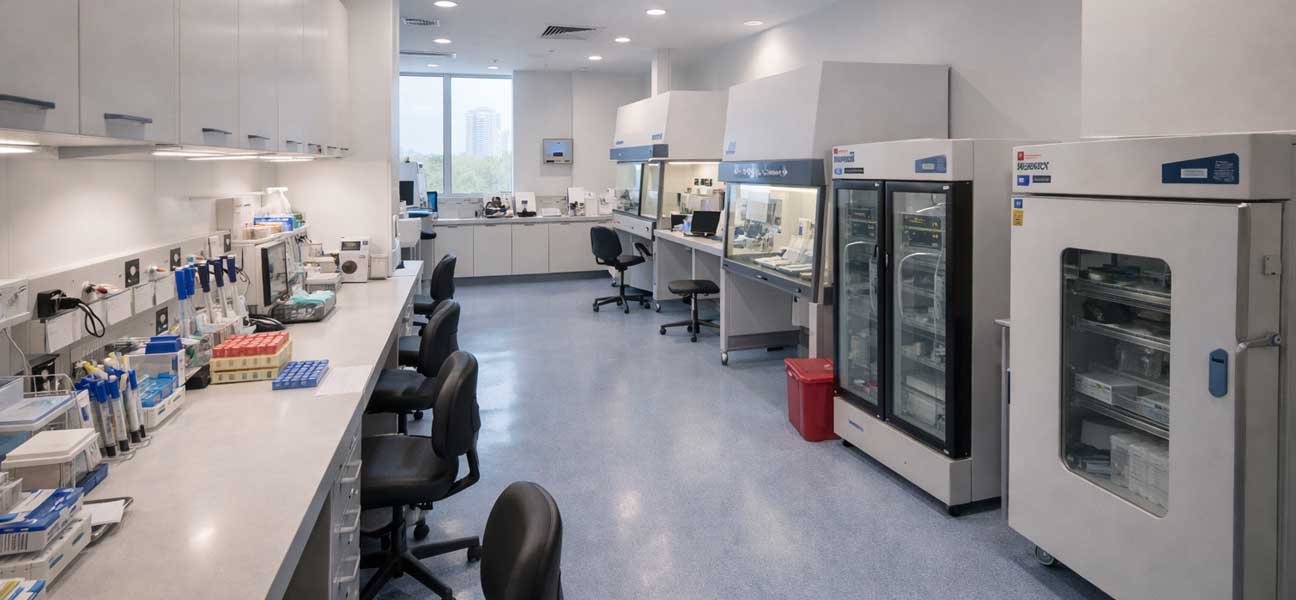
In assisted reproduction, the quality of the laboratory accounts for over 40% of the success rate. A reproductive doctor with 10 years of experience once said bluntly: "Stimulation protocols can be adjusted, embryologist skills can be discussed, but if the laboratory environment has problems, even the best eggs cannot be saved." ESHRE accreditation is not a simple "honor"; it signifies that the laboratory has passed regular, third-party, traceable audits in the following core areas:
- Air Quality Management: VOC (Volatile Organic Compounds) concentration in incubators, HEPA filtration systems, temperature and humidity fluctuation thresholds.
- Culture Media Quality Control: Supplier verification for each batch of culture media, endotoxin testing, osmolality records.
- Cryopreservation Standards: Liquid nitrogen tank temperature monitoring and alarm systems, SOPs for freezing/thawing procedures.
- Embryo Traceability: DNA labeling or biometric identification system for each embryo from retrieval to transfer.
- Personnel Training: Embryologists must participate in ESHRE accredited courses or equivalent training and maintain continuing education records.
Lack of accreditation does not necessarily mean poor quality, but accreditation provides a known, comparable quality baseline. For patients undergoing PGT (Preimplantation Genetic Testing), laboratories are exposed to frequent biopsy procedures, increasing contamination risk, making the relative advantage of accredited laboratories more pronounced.
3. Common Pitfalls: The Gap Between Accreditation and Marketing
Based on professional observation, patients most commonly fall into the following traps:
- Confusing "Association Membership" with "Laboratory Accreditation": Many Georgian institutions state on their websites "We are ESHRE members," but this only means an individual doctor at the institution has paid personal membership fees, which has nothing to do with laboratory quality audits.
- Expired Accreditation Not Updated: ESHRE accreditation is typically reviewed every 3-5 years. Some institutions obtained accreditation years ago but failed subsequent re-evaluations and continue to use the old accreditation for promotion. It is recommended to directly search the institution's English name on the ESHRE official website's "Accredited Centres" page.
- Partial Accreditation Only Covers Specific Processes: Some laboratories are only accredited for "oocyte cryopreservation" but vaguely promote it as "full-process accreditation." When inquiring, explicitly request a scanned copy of the accreditation certificate and verify the scope of accreditation.
- Lack of Transparency with Partner Laboratories: In a few Georgian clinics, egg retrieval and embryo culture are done in Laboratory A, but genetic testing samples are actually sent to unaccredited Laboratory B, leading patients to mistakenly believe the entire process is accredited. Always verify each step.
4. Differences Between Clinics/Laboratories and Suitable Patient Groups
Even among accredited laboratories, there are differences in operational focus. The following comparison is based on public information and patient feedback:
| Comparison Dimension | Chachava Clinic | Zhordania Clinic | IVF Georgia |
|---|---|---|---|
| Embryo Culture Advantage | Experienced in culturing >10 embryos per cycle | More stable micro-culture system for low follicle count (≤5) | Mature interface with third-party embryo genetic testing labs |
| PGT Cycle Volume | Approximately 300-400 biopsy cycles per year | Approximately 150-200 per year (in collaboration with institute) | Primarily accepts PGT-A, fewer PGT-M cases |
| Frozen Oocyte/Embryo Inventory Management | Uses double-layer nitrogen tanks + remote alarm system | Manual inspection + paper records + electronic backup | Standard liquid nitrogen tanks with automatic filling system |
| Patient Nationality Distribution | Eastern Europe, Central Asia, China (approx. 40%) | Local Georgians, CIS countries | Israel, USA, China (approx. 30%) |
| Suitability for Advanced Age/Poor Ovarian Response | Second choice (advantage is high volume, not fine-tuning) | First choice (experienced in micro-culture and single follicle tracking) | Moderate (depends on third-party culture quality) |
When is it suitable to choose an accredited laboratory? For patients with recurrent implantation failure, high embryo fragmentation rates, requiring PGT (especially PGT-M/PGT-SR), or those who highly value laboratory process transparency, accredited laboratories should be the first choice.
When should you not overemphasize accreditation? If a patient is facing severe endometrial issues or immune factors, the contribution of laboratory accreditation to the outcome may be diluted by other factors. In such cases, priority should be given to clinics specializing in hysteroscopy combined with medication management.
5. The Most Overlooked Detail: "Actual Implementation" of Accreditation Matters More Than the Certificate
An overseas coordinator based in Georgia shared a real case: An accredited laboratory did a month-long intensive cleanup of records just before the re-evaluation, but three months after passing, it reverted to a "good enough" state. Accreditation is a snapshot in time; daily quality depends on process culture and internal audits.
Patients can indirectly assess quality during consultations through the following details:
- Ask if embryologists regularly attend ESHRE annual meetings or online workshops. Can they provide attendance records from the last two years?
- Is the number of times incubator doors are opened controlled? Can patients' families observe through a monitoring window (many labs refuse for hygiene reasons)?
- Are regular post-thaw survival statistics for frozen embryos publicly available? Can they show monthly reports from the last three months?
- Is there an independent quality control officer (not the lab director holding a concurrent position)? Can QC meeting minutes be reviewed?
6. Frequently Asked Questions (Practitioner Observations)
Q1: Are there any ESHRE-accredited third-party embryo testing laboratories in Georgia?
Currently, there is no independent third-party genetic testing laboratory in Georgia that has obtained ESHRE accreditation. All PGT samples must be shipped to accredited genetic testing centers in Europe (e.g., Greece, Spain) or Israel. Transporting samples with frozen embryos must comply with the EU Human Tissue Directive. It is recommended to clearly define the responsible party for transport and compensation terms for sample loss/damage in the contract.
Q2: Do accredited laboratories necessarily have higher embryo culture success rates?
Not necessarily. Accreditation is a necessary condition, not a sufficient one. The latest ESHRE official statistics show that the average clinical pregnancy rate in accredited laboratories is about 5-8 percentage points higher than in non-accredited laboratories (for patients under 35 without uterine factors). However, for patients over 40, the difference narrows to 2-3 percentage points, as the outcome is primarily determined by egg quality.
Q3: Is it reliable if a chosen laboratory claims to be "applying for accreditation"?
The application itself is a positive sign, but the progress needs to be confirmed. The ESHRE accreditation process includes a written self-assessment, pre-audit, on-site audit, corrective actions, and final review, typically taking 12-18 months. If the institution is at the "application submitted" stage and has not yet received pre-audit feedback, it is advisable to wait six months before considering them. If they have passed the on-site audit but not yet received the official certificate, you can request a summary of the audit report.
7. Doctor's Advice: How to Plan Your Laboratory Accreditation Verification Process
If you are selecting a laboratory in Georgia, follow these steps to avoid being misled by marketing:
- Step 1: Visit the ESHRE official website (www.eshre.eu) → Go to "Accreditation" → "Accredited Centres" page, select country "Georgia." The results displayed on the official page are the most accurate list.
- Step 2: If an institution claims accreditation but is not found on the official website, request the accreditation certificate number and send an email to the ESHRE accreditation secretariat (accreditation@eshre.eu) for verification. Replies typically take 3-5 business days.
- Step 3: Confirm that the scope of accreditation covers all the procedures you need. For example, if you are doing PGT, ensure "embryo biopsy procedures" are within the scope; if you are only freezing eggs, ensure "oocyte vitrification" is within the scope.
- Step 4: Request the laboratory to provide embryo data from the last 12 months (MII rate, fertilization rate, blastocyst rate, post-thaw survival rate, usable embryo rate after PGT biopsy). If they refuse, consider it a risk factor.
8. Risk Reminder: Accreditation is Not the Only Safeguard
Even with ESHRE accreditation, the following risks cannot be completely avoided:
- Changes in laboratory personnel (e.g., the lead embryologist present during accreditation leaving) may lead to a decline in standard implementation.
- Temperature fluctuations during sample transport (especially cargo hold temperature issues on airlines in winter).
- Coordination issues between the overseas clinic and local lawyers/medical interpreters may affect subsequent rights regarding embryo disposition.
Accreditation is a marker of a quality foundation, but the final decision should still be based on your specific medical condition, the clinic's overall service capabilities, and legal protections (including embryo ownership agreements, donor egg compliance, legal authorizations, etc.).
Any claims of being "the only accredited" or "the best in Georgia" should prompt an additional verification step. Accurate information comes from official channels and first-hand audit records, not sales pitches.
Comments (0)