
Yesterday afternoon, I received a message from a client: "I've been staying in Tbilisi for a week now. The clinic I booked earlier said the doctor is on leave. I found an institution called 'National Center for Reproductive Medicine of Georgia,' but the map shows two results. Which one is real? Can you help me confirm the address?" This question is not uncommon—Georgia's reproductive medical resources are expanding rapidly, and there is more than one center with a similar name. Official public institutions and private clinics are easily confused.
Where is the National Center for Reproductive Medicine of Georgia
The National Center for Reproductive Medicine of Georgia is located in the core medical district of the capital, Tbilisi. The specific address is: 52 D. Uznadze Street, Tbilisi, Georgia. This institution is adjacent to the Tbilisi State Medical University Hospital and is a public specialized center directly under the Ministry of Health of Georgia. The main entrance of the building features a prominent national medical logo, giving it the appearance of a non-commercial medical facility.
GPS Coordinates: 41.7236° N, 44.7935° E. You can navigate directly by searching the English name "National Center for Reproductive Medicine Tbilisi" on Google Maps or Waze. Be careful not to confuse it with "GGRC" (Georgian Genetics and Reproductive Center) on the same street, which is a private institution located at number 78.
Public Transport & Parking
- Metro: The nearest metro station is "Marjanishvili Station" (Line 2), about a 12-minute walk from the station.
- Bus: Take bus routes 14, 37, or 46 and get off at the "Uznadze Street" stop, then walk for 5 minutes.
- Driving: The hospital has a surface parking lot, but spaces are limited. It is recommended to arrive before 8:00 AM or after 2:00 PM. There are paid parking lots nearby, a 3-5 minute walk away.
Why You Need to Know the Difference Between Public and Private Institutions
Georgia has over 30 reproductive assisted conception institutions, more than half of which are private commercial clinics. As a public institution, the National Center for Reproductive Medicine has its fee standards regulated by the government. The cost of a basic IVF cycle is typically 30%-50% lower than at private clinics, but waiting times are longer, and doctors do not offer Chinese-language WeChat consultation services. Many patients searching online for "National Center for Reproductive Medicine Georgia" are misled by advertisements to private institutions with double the prices.
According to 2024 data from the Ministry of Health of Georgia, this public center performs approximately 5,400 assisted reproductive cycles per year, with foreign patients accounting for about 12%. Its main services include: IUI (Intrauterine Insemination), IVF/ICSI, PGT (Preimplantation Genetic Testing), egg freezing, and fertility preservation. It is important to note: this center only provides IVF using the patient's own eggs/sperm and does not accept donor eggs or sperm for embryo transfer (Georgia allows third-party assisted reproduction, but this service is usually provided by private institutions).
Department Structure and Patient Procedure at the National Center for Reproductive Medicine of Georgia
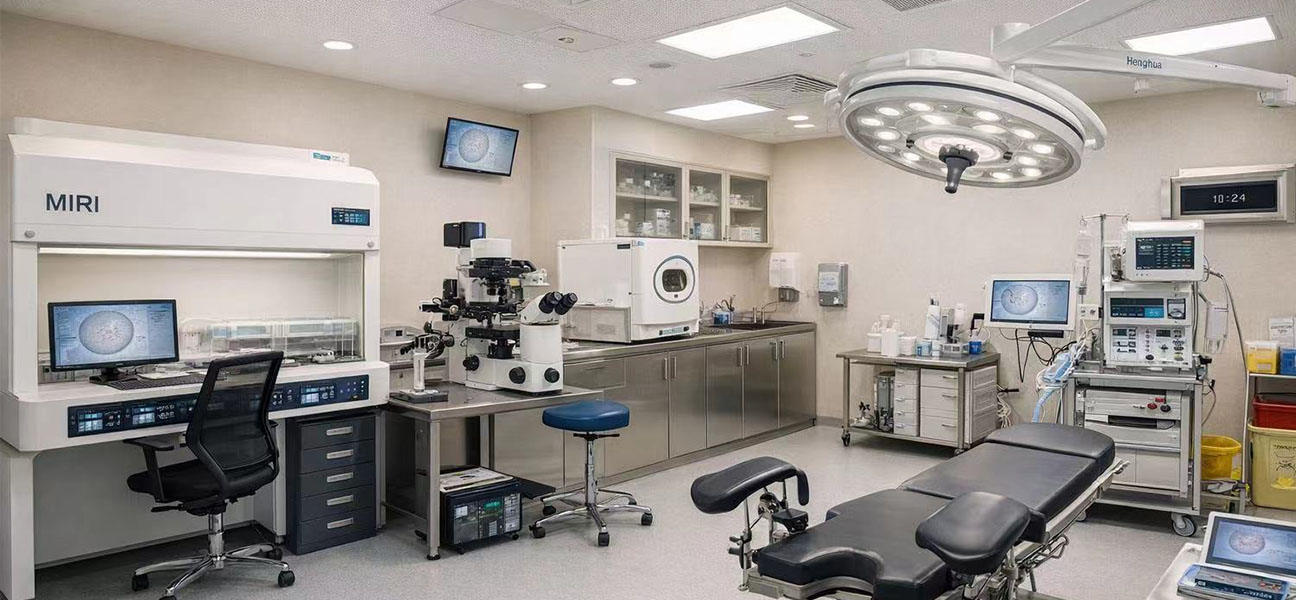
The hospital is divided into four main functional areas: Reproductive Gynecology Outpatient Clinic, Andrology Laboratory, IVF Operating Room, and Genetic Testing Center.
Required Documents for the First Visit
| Item | Requirement | Notes |
|---|---|---|
| Original Passport | Valid for at least 6 months | Photocopy required |
| Previous Medical Records | Translated into Russian or English | Include surgical records, ultrasound reports, hormone test results |
| Recent Test Reports | Valid within 6 months | AMH, sex hormone panel (6 items), semen analysis, infectious disease panel (4 items) |
| Visa | Tourist visa or e-visa | No special medical visa required |
| Power of Attorney | Needs notarization if one spouse cannot be present | Must be notarized in Chinese and English and authenticated by the consulate in your home country |
Procedure Timeline
- Weeks 0-2: Complete tests in your home country and send reports for online pre-screening.
- Week 3: Arrive in Tbilisi. Bring all original paper documents to the International Patient Reception Desk on the first floor to register.
- Week 4: Consultation with the attending physician, development of a treatment plan, and signing of informed consent.
- Weeks 5-6: Start the cycle on day 2 of menstruation, begin ovarian stimulation (average 12 days).
- Week 7: Egg retrieval surgery (outpatient procedure, can go home the same day).
- Weeks 8-10: Embryo culture + PGT testing (if required), waiting for results.
- Week 11: Frozen embryo transfer (natural cycle or hormone replacement cycle).
- 12 days after transfer: Blood test for pregnancy.
Easily Overlooked Details
1. Language Barrier: Doctors at the center primarily speak Georgian and Russian; some can communicate in English. If you need a Chinese interpreter, you must book at least 48 hours in advance via the hospital's official email (paid service, approximately $50/hour). Finding an interpreter on the spot is very unlikely.
2. Validity of Test Reports: Serology reports for HIV, syphilis, hepatitis B, and hepatitis C are only valid for 3 months. If your tests are too old, you will need to have blood drawn again upon arrival. It is recommended to complete all infectious disease screenings within 1 month before departure.
3. Medication Formulation Differences: The ovarian stimulation medications used at the public center (e.g., Gonal-f, Menopur) are standard products from major international manufacturers. They do not offer "premium upgrade packages." The "imported high-purity medications" often marketed by private clinics are used routinely here without any extra charge.
Differences in Treatment Based on Individual Circumstances
Impact of Age on Treatment Protocol
- Under 35, normal ovarian function: Standard antagonist protocol with a stimulation dose below 400 IU, expecting 8-15 eggs retrieved. The center does not advocate blindly increasing the dose.
- 35-40 years old, AMH 1.1-2.0 ng/ml: Doctors tend to use a short protocol or mild stimulation, combined with growth hormone pre-treatment. You need to start taking oral Coenzyme Q10 and DHEA (with a doctor's prescription) one month in advance.
- Over 40, AMH below 0.8: Doctors will clearly inform you of the expected success rate (usually a live birth rate below 10%) and recommend considering egg donation. Those who do not meet the criteria may be directly advised to abandon their own egg cycle.
Differences in Procedure for International vs. Local Patients
Foreign patients must make appointments through the International Patient Coordination Office and cannot directly call to register. The first consultation fee is $150 (includes package interpretation), and subsequent ultrasound monitoring is $30 each time. Local residents can have some costs covered by the national health insurance, while foreign patients pay the full cost out-of-pocket, but the price is still 30%-40% lower than private hospitals.
Frequently Asked Questions
- Q: Can the National Center for Reproductive Medicine of Georgia perform PGT (Preimplantation Genetic Testing)?
- Yes. The center has an NGS sequencing platform and can perform PGT-A (aneuploidy screening) and PGT-M (monogenic disease testing). Please note that PGT cycles require additional ethical review application to the Ministry of Health, which takes about 2-4 weeks.
- Q: What tests should I do in advance in my home country?
- At a minimum, you need: AMH, sex hormone panel (days 2-4 of menstruation), vaginal ultrasound (to count antral follicles), semen analysis (abstinence 2-7 days), complete blood count, coagulation panel, infectious disease panel (4 items), and thyroid function. Karyotype analysis is recommended but not mandatory. If you are over 38, a hysteroscopy is also needed to rule out endometrial pathology.
- Q: If the first IVF cycle fails, how soon can I start another cycle?
- Doctors usually recommend waiting 2-3 menstrual cycles. If a frozen embryo transfer fails, the endometrial protocol can be adjusted for the next menstrual cycle. If there are no usable embryos after stimulation, you need to wait for the ovaries to recover, usually restarting after 3 months.
A Practitioner's Observation: A Realistic Tip About the Public Center
As an overseas coordinator, I have assisted 47 clients in completing IVF cycles in Georgia over the past three years, 12 of whom chose the National Center for Reproductive Medicine. Here are two objective pieces of advice: First, the laboratory quality control at the public center is very stable, with no over-marketing of "new batch of culture media," but equipment updates are slower than top-tier private institutions (e.g., time-lapse incubators and AI embryo scoring systems are common in private clinics, while this center still relies mainly on visual assessment). Second, doctors at the public center have fixed outpatient hours each week. For emergencies (such as post-operative ascites or abnormal bleeding), you need to go to the emergency department; there is no 24-hour dedicated doctor channel. This is especially important for overseas patients.
Time Planning Reminder
Spring and autumn in Georgia have stable weather. It is recommended to plan your trip between April-June or September-November. Winter has more snowfall, which can cause traffic congestion on some roads leading to the suburbs of Tbilisi. There is no jet lag adjustment needed from China (4 hours behind Beijing time). It is advisable to allocate a full 7 weeks in Georgia to complete a fresh cycle (add another 2-3 weeks for PGT results). If you are only doing a frozen embryo transfer, an average stay of 14 days is sufficient. Be sure to formally confirm your appointment via email before departure and keep the doctor's reply as proof in case you are questioned by customs upon entry.
Comments (0)